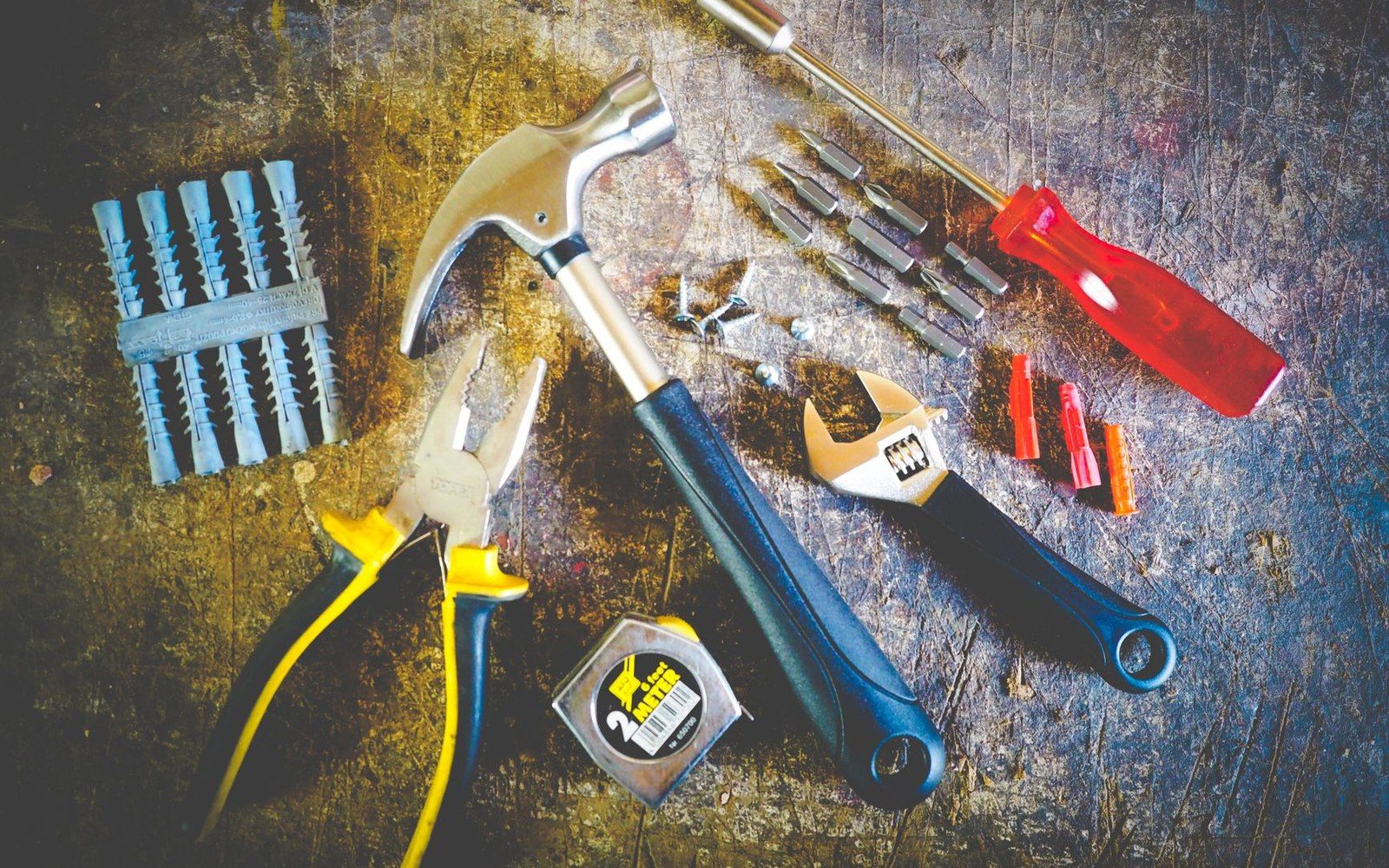
 Photo: energepic.com / Pexels
The Short List: Tools That Cover Most of What Breaks
A small kit chosen by what breaks most, not by what looks complete
A full tool roll is a vanity project. What matters is coverage: the ability to open, diagnose, fasten and cut across the widest range of failures. The list below handles the majority of household, clothing and electronics repairs without redundancy.
Screwdrivers first, because nothing else matters until you can open the thing. A cross-head (Phillips PH2) and a flat-head (5mm) cover most appliance casings and furniture fittings. Add a PH0 for small electronics. Beyond those three, reach for a precision set — six to eight bits in a magnetised handle — because modern electronics lean heavily on Torx T5, T6 and T8, and on tri-point and pentalobe fasteners. Don't buy a 58-piece set where forty bits will never touch a screw: hidden fasteners are specific, and the correct bit is usually one of a short list.
Pliers: two kinds, not five. Long-nose pliers grip, position and pull in spaces fingers can't reach. Slip-joint pliers give mechanical advantage for stuck fittings. Both reward quality — the joint should be tight with no lateral wobble, the jaws ground parallel when closed. Avoid sets with rubber grips moulded over thin pressed steel: the grip hides poor construction.
Knives and scissors. A retractable utility knife with replaceable blades handles vinyl, cardboard, gaskets and trimming. A dedicated pair of fabric scissors — kept away from paper and tape — is essential if clothing and textiles are in scope. Fabric scissors blunted on cardboard are useless; label them and mean it.
Adhesives, chosen by substrate. A cyanoacrylate (superglue) handles most rigid non-porous bonds: ceramic, metal, hard plastics. Epoxy adhesive (two-part) is better for load-bearing joints where cure time is acceptable. A fabric glue or seam sealer covers textile repairs where stitching isn't possible. No single adhesive works on everything; three covers nearly all domestic failures.
A multimeter. A basic digital multimeter — continuity, DC voltage, resistance — diagnoses more problems than any other single tool in this list. It tells whether a fuse has blown, whether a cable carries power, whether a motor winding is open. A second-hand unit from a reputable brand (Fluke, Uni-T, Mastech) in working condition is preferable to a cheap new one. Check that the probes are intact and the battery is live before buying used.
Needle and thread. Heavy linen or polyester thread on a curved needle handles upholstery, bags and shoe linings. Standard sewing thread with a set of sharps covers clothing. A seam ripper is worth adding: unpicking without it destroys surrounding fabric.
The case for buying tools second-hand. Quality signals on used tools are readable. Look for machined (not stamped) jaws on pliers, a clean chrome-vanadium or S2 steel stamp on screwdrivers, and solid — not hollow — feeling handles. Avoid tools with visible cracks in the body, loose rivets at the joint, or corrosion inside the jaw hinge. Car boot sales and tool reconditioners carry professional-grade tools shed from estates and retired trades; a 1970s British or German screwdriver is often better steel than a new budget equivalent.
The kit above fits in a single canvas roll or a small metal box. Anything not on it is either a specialist tool for a specific job — worth acquiring when that job arrives — or a duplication of coverage already present. Resist the hardware-shop display; repair is served by depth of use, not breadth of ownership.