A Saturday Morning at a Repair Café
The volunteers arrive before the public does
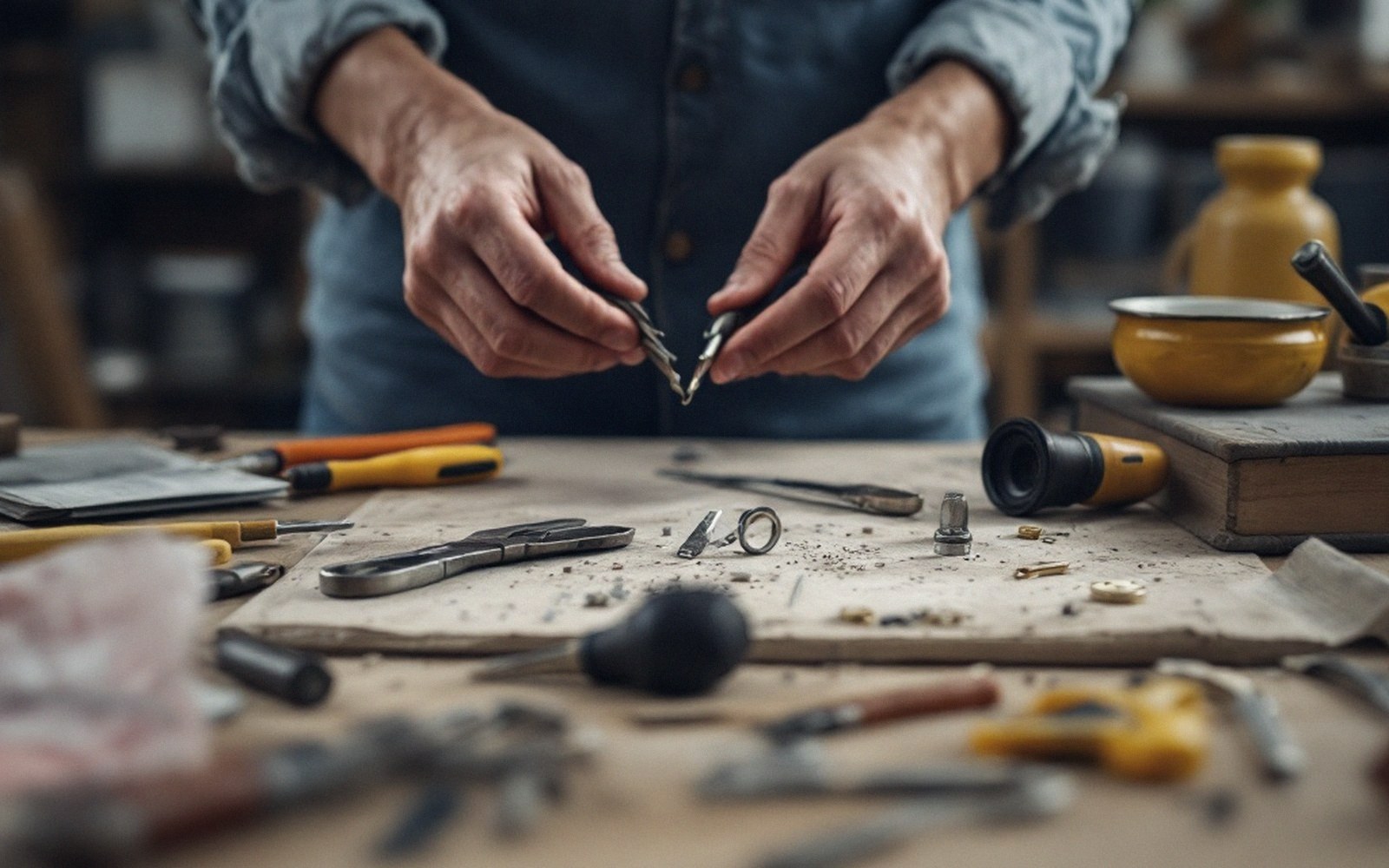
By nine o'clock the tables are already covered in toolboxes. A retired electrician claims the corner nearest the window — good light for reading component markings. Across from her, a man who spent years as a sewing machine technician lays out a row of presser feet in ascending size order, though he probably will not need most of them. Someone is setting up a parts washer improvised from a takeaway container. The kettle has been on since eight-thirty.
Repair cafés have spread widely across Europe and beyond since the concept was formalised in the Netherlands in the early 2010s. The format is consistent enough that walking into one — whether in a community hall in Lyon, a library meeting room in Bristol, or a church basement in Berlin — you encounter roughly the same thing: volunteers with skills, strangers with broken objects, and no guarantee of success for either party.
That last point matters. A repair café is not a workshop with a service desk. It is closer to a slow, sociable triage. Some things get fixed completely. Some get a partial diagnosis. Some leave in the same condition they arrived in, but with a clearer understanding of why, and a note about what a professional repairer would need to do. The session described here draws on the kinds of events that take place regularly across these networks — the specifics composite, but the texture real.
ON THE BENCH · WHAT TO BRING — QUICK REFERENCE
What comes through the door
The first object of the morning is a floor lamp. Its owner, a woman in her seventies, says it stopped working suddenly. The electrician takes it, checks the bulb — fine — then opens the inline switch with a small flathead. The contact inside has corroded. She cleans it, tests continuity with a multimeter, closes the switch. The lamp works. Elapsed time: eleven minutes. The owner looks disproportionately pleased, which is one of the recurring surprises of these sessions: small fixes produce a warmth that is hard to account for purely in economic terms.
By ten the tables are full. A man has brought a radio cassette player from around 1990. A teenager — accompanied by a parent, since most cafés ask under-sixteens to bring an adult — has a laptop with a broken hinge. There is a canvas bag with a split handle seam, a hand-drill with a jammed chuck, a child's winter coat with a failed zip, and a ceramic lamp base that has cracked cleanly in two.
The mix is typical. Repair cafés tend to cluster around four or five categories: small electrical appliances and electronics, clothing and textiles, bikes and mechanical objects, ceramics and furniture, and anything else that someone decides to carry in. The coverage depends entirely on who has turned up to volunteer that day. A session without a textile person means the coat waits, or leaves unfixed. A session without anyone confident with electronics means the radio stays closed. Volunteer coverage is the most unpredictable variable in the whole enterprise.
The radio cassette player takes longest. A volunteer with electronics experience opens it, identifies a dried-out belt — the drive belt for the cassette mechanism has perished and snapped. He does not have a replacement in his kit. He writes down the belt's dimensions (taken by measuring the broken piece) and tells the owner where to source one online, and what to search for. The player leaves unrepaired but the owner has a path forward. This is a legitimate outcome.
The laptop hinge is more complicated. Hinge repairs on modern thin laptops frequently require a replacement part specific to the exact model. A volunteer looks up the model number, finds that the hinge assembly is available as a spare part, but the repair itself requires removing the screen bezel — thin plastic, high tab-breakage risk — and is more than the session can safely attempt without the right part on hand. The teenager is given the model number, a parts supplier URL, and a note of what the job involves. Whether this is a fix for a confident DIY repairer, or a job to take to an independent repairer, depends on factors that only that teenager can assess.
What actually gets fixed — and what does not
The canvas bag handle seam is repaired completely, by hand, in about twenty minutes. The volunteer uses a heavy curved needle and waxed linen thread — both from her own kit — and works a backstitch along the original seam line before adding a second pass. The owner watches. Some do; some wander off for tea.
The hand-drill chuck is jammed because grit has worked into the mechanism. The volunteer disassembles it, cleans and re-oils the jaws, and tests it on a scrap of wood someone has brought for exactly this purpose. Fixed.
The ceramic lamp base is repaired with a two-part epoxy. The volunteer warns the owner that the repair will be visible at close range, and that the bond will be strong but the repaired piece should not be dropped again — an unreinforced epoxy join on ceramic is not as tough as the original material. The owner accepts this and the lamp leaves with the two halves bonded and clamped.
The winter coat zip is a replacement job. The old zip cannot be repaired — the slider has split along its spine, a failure mode where the slider body itself separates and can no longer tension the coil. A new zip needs to be sourced and sewn in. The textile volunteer can do this, but not today: she does not have a replacement zip of the right length and colour in her kit. She notes the zip type (coil, not tooth), the length, and the colour, and tells the owner what to buy and where to find a seamstress or tailor if they do not want to do it themselves. Another incomplete outcome — useful, but not finished.
By eleven-thirty, the session has seen fourteen objects. Of those, roughly half leave fixed. Three leave with a clear diagnosis and parts list. Three leave with a referral — to a professional, to a parts search, or to a different kind of repair event. One leaves unchanged: an espresso machine with a pump fault that, on opening, turns out to involve the mains wiring in a way that stops the repair there. The volunteer closes the machine, explains why she is not going any further, and suggests the owner either finds a qualified appliance repairer or considers whether the machine is worth the cost of a professional fix.
No pressure. No guilt. That is also part of the culture.
ON THE BENCH · HOW OUTCOMES TYPICALLY FALL
What to bring — and how to prepare
The single most useful thing to bring is information. The brand, model name, and model number of anything electrical or mechanical — written down, not just on your phone. A volunteer troubleshooting a blender in a noisy community hall does not want to squint at a screen; a piece of paper works. If the object has a manual, bring that too, or download a PDF before you arrive and keep it accessible.
Bring the object in a state that makes diagnosis possible. An appliance that fails intermittently is harder to assess than one that fails consistently — describe the failure precisely: what it does, what it does not do, whether the failure is new or gradual, whether anything happened before it failed. Context is evidence.
For clothing and textiles, bring the garment washed and dry. Bring any detached buttons, spare fabric if you have it, and a clear idea of what finish you want — invisible repair or visible, machine-sewn or hand-stitched. For bikes, basic mechanical repairs are common; electrical system faults on e-bikes are less likely to be within café scope.
Do not expect speed. A complex object might occupy a volunteer for an hour. Simpler repairs happen faster, but the queue moves at the pace of diagnosis, not of throughput. Bring something to read.
Repair cafés do not charge for labour, though most ask for a donation to cover consumables — solder, thread, glue, cleaning supplies. Some keep a small stock of common parts: fuses, capacitors, belts, buttons. None carries everything. The more obscure the part, the more likely you are to leave with a list rather than a fix.
Finally: some objects are not repair-café material. Mains-wiring faults beyond simple switch and plug work. Structural furniture repairs that require a workshop and clamps and time. Appliances where the failure is clearly terminal and the economics point toward replacement. Bringing these is not wrong — the diagnosis is still useful — but adjusting expectations before arrival makes the session more productive for everyone. The volunteers are skilled, not magical. They work on what they have in front of them, with what they carry in their toolboxes, in two hours on a Saturday morning. That is the constraint, and within it, quite a lot gets done.